
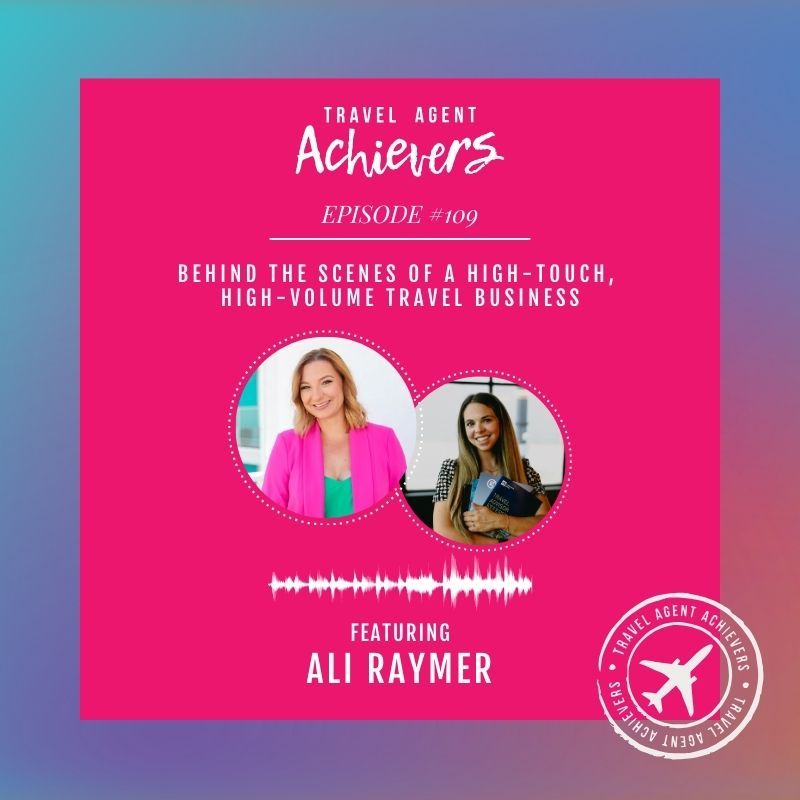
Episode 109:
Behind the Scenes of a High-Touch, High-Volume Travel Business with Ali Raymer
You can listen directly here.
In this episode of the Travel Agent Achievers Podcast, Ros is joined by Ali Raymer, Senior Travel Advisor with Picture This Travel in the US. Ali works across honeymoons, celebration travel, complex itineraries and group travel, and has built a business centred on confidence, care and meaningful client experiences, while managing significant sales volume and a growing team.
This is a practical, honest conversation for travel advisors who care deeply about their clients but also want a business that supports them long-term.
In this episode, we cover:
- What “high-touch service” really looks like behind the scenes
- How systems actually protect the client experience, not remove the personal touch
- Managing high booking volume without dropping standards or details
- The importance of follow-ups, welcome home processes and client feedback
- Setting boundaries to prevent burnout and protect family time
- When and how to bring in support as your business grows
- What to outsource first and what to protect as the advisor
- Time blocking, routines and energy management
- How to plan for growth without losing sight of why you started
Ali shares openly about the tools she uses, the lessons she’s learnt while scaling, and the mindset shifts required to move from doing everything yourself to building a sustainable travel business.
If you’re feeling stretched, overwhelmed, or unsure how to grow without losing control, this episode will give you clarity and practical ideas you can start applying straight away.
Subscribe wherever you listen to podcasts, and if you enjoyed this episode, please leave a review and get in touch with us. The more we know and learn about you, the more it helps more travel professionals find us and grow. For more tools and support, visit www.travelagentachievers.com and join our community.
Links Mentioned in the Episode
Connect with Ali:
Website: www.alipicturethistravel.com
Linkedin: https://www.linkedin.com/in/alipicturethistravel/
Instagram: https://www.instagram.com/alipicturethistravel/
Youtube: @alipicturethistravel
Quotes from this Episode
“The leads are endless. You just have to have a way to nudge people into the systems that you create, otherwise you’re going to drop the ball.” - Ali
“High-touch service doesn’t happen by accident. It’s supported by systems, boundaries and thoughtful decisions behind the scenes.” - Ros
“I really do think boundaries are a fence to protect your family. They’re not there to keep people out.”- Ali
“If you’re just constantly chasing a number goal, you’re not always chasing the day-to-day life you actually want.” - Ali
Subscribe & Review on Apple!
Get first access to our latest episodes! If you haven’t already, make sure you subscribe to the Travel Agent Achievers podcast. Each week we release a new episode that will help increase your knowledge and expertise as a travel agent. Click here to subscribe to Apple.
Once you’ve subscribed, leave us a written review on iTunes or your favourite podcast platform. Simply click here to give us a review, select “Ratings and Reviews” and “Write a Review.”
If you have any colleagues that this information may be useful for, share an image of this podcast on socials and make sure to tag us!
@travelagentachievers
READ THE TRANSCRIPT IF YOU PREFER - BELOW
Behind the Scenes of a High-Touch, High-Volume Travel Business with Ali Raymer
Ros: Hi everybody. Welcome back to the travel agent achievers podcast. It's Ros here. Now, today's episode is a really practical one. It's one for those of you that are juggling full diaries have high client expectations, and we all know like what that means and the desire you have, the desire to grow your travel business without burning out. I am joined by Allie Raymer, a senior Travel Advisor, with picture this travel in one of my favorite countries, the US of A ally is based in Kentucky. She works across all the things, honeymoons, celebration, travel, complex itineraries. And she also has led group tours across many destinations and helped her clients with traveling to places like Belize, hey, I love the diving, the Mediterranean, you know, European World War tour tours. She plans Bali honeymoons, European celebrations and family holidays. She has built a business centered on confidence, care and meaningful travel experiences. Now what stood out to me about Ally's approach is how she delivers a very high touch client experience whilst maintaining and managing a significant volume of bookings. Now, as I said, she's doing all the things. So in today's conversation, we're stepping away from the highlight reel and all the bits and pieces of social media, and we're talking about what actually happens behind the scenes of a high touch, high volume travel business, we're going to explore the systems, the structure, some decisions that support great client experiences, how to grow without losing control. And I know this is one that a number of you have asked me about, and what it really takes to deliver personalized service in a sustainable way. So if you deeply care about your clients, which I know you do, but you also want a business that supports you long term, this episode is going to give you plenty to think about and also hopefully take action on, which you know is what I always want. So let's jump straight into the conversation. Welcome Allie to the travel agent achievers podcast.
Ali: Thank you so much for having me. That was a brilliant introduction. I feel like, Oh, thank you.
Ros: I love that. It's like, Hi, yes, that's me.
Ali: Hello, we're here. Yeah, this is going to be so fun. And I really hope it's super practical. I am just like, my whole persona is being my client's biggest cheerleaders, but I also just want to be hype people for other advisors in the industry. So we could all use a little bit of hype and practicality. So we're going to hopefully bring that today.
Ros: I love it absolutely we are going to bring that. Can I just ask, were you a cheerleader in high school? I was not No, neither was I. But that's a phrase that I often use, that I am going to champion you until, like, I will believe in you, until you believe in yourself, and I will say that I'm the biggest cheerleader for everybody else. So I just was curious. No, you weren't. Yeah, I was not. So Ali, can you just give us a little bit of a brief overview as to your introduction to travel and what you're currently doing now.
Ali: Yeah, absolutely. So I jumped into the travel business back in 2017 I was brought on by my husband's aunt. Actually, she owned her own boutique agency, and I was a high school English teacher, and I was selling travel to high school students in a low income area, and we were doing a lot of fundraising and getting those trips off the ground. And I was actually doing pretty well selling. And my husband's aunt said, why don't you start selling travel to people with money? And I was like, Oh, wow, this is that sounds great. And so it just kind of started there, you know, in the summers, I would go to her home office and just learn literally from the best. She's such a master sales woman. And I would learn from her, because I do not have a, you know, background or education and marketing or sales or anything like that. And I just learned from her and mentored under her. And you know that was in 2017 so survived all the pandemic craziness and came out the other side with all this wild revenge travel over the last few years, and actually grown a team myself. So I have six agents that I now mentor at picture this travel, and we've grown our business a ton. So this year, my sales volume is like two and a half million. That will end the year with and my team is probably at about five to 6 million for my team so and they've all just started within the last few years. So it's so. Aggressive to see the way that they've grown as well.
Ros: That's amazing. And hey, thank you for being so open about the numbers, because it's one thing that in this industry, I don't think people talk about enough, and there are so many differential factors in you know, how much to sell, where people are at. And there is no judgment. There is no you know, you should be doing this, and what if you did these things, you'd get this amount of money. I think everybody is on their own journey, but that just also, for anybody that's listening, just gives you a bit of context as to the volume and what it also means from a service level, especially when you have teams supporting you or team that are also running their own businesses within your business, the complexities that go with that, which is really why I wanted to have this chat with you, because systems and you know, structure is so important, but I also think that what we have in this industry really needs to be about that human connection and the high touch we need to in order to stay relevant, have those mannerisms and have that connection with other humans, because it is a human business, right? We're helping other people travel and, you know, explore this incredible planet that we live on, but you have to be able to talk to people. So it's not all about having the systems to produce those high volumes. It is also about that human connection. But what is really important is what happens behind the scenes. So when people hear high touch service, what do you think that they often don't see happening behind the scenes? What do you think? Is it like high touch service versus, hey, I've got this step by step system over here, right?
Ali: Right. That's so important to me to feel like every client is my best friend. Honestly, I want to be able to run into them and catch up with them. And I want their them to feel like their trip is so very special, whether they're spending $5,000 or $50,000 and I think that's really important to figure out your why. You know, why are you doing what you're doing in this business? And for me, it is truly helping people feel confident with their travel plans. And I think as soon as you can, kind of like, come into their space and again, really champion them and cheerlead them into whatever direction, if it's an all inclusive to Mexico, I'm like, this is about to be the best trip ever. We're going to hype you up, you know. Or maybe it's this huge African Safari. Or, you know, they're going to Italy for the first time, in Europe for the first time, so just making them feel super heard, super special. To me, that's everything I would want every single one of my clients to be like, I don't know, like Allie thinks I'm her favorite. Really, you
Ros: Really, you know, interesting that you say that, because one thing like that is a beautiful thing for your clients to know and believe and really feel. One thing that I say, and I know my clients know, is, if the shit hits the fan, like if they are in a situation, they want me on their side, because I remain cool and calm under pressure. I am one. I'm somebody who can just figure things out on the fly, make decisions, help and support, calm everything down, know which next step to take. So I love that you've got that, that hype and energy, and the clients are your best friend. And here am I over here, going, that's all right, if the shit hits the fan, I got you.
Ali: I love that you need, you need that person in your corner, though, because it will, it will,
Ros: Well, that's true, but you want to hope that you never need that. But it's that peace of mind. So having those relationships bill that the clients know, like and trust you, what you said, there was also they feel heard and that you've got them, and I think that that is really special when we talk about high touch service. No, so what? When you're working with your clients, you know there's you've got a lot of volume in your business. As you said, with those numbers, how do you still keep things personal?
Ali: For sure, the volume is something that I have to really watch. I have to make sure that the clients that I'm bringing in, I'm kind of not forcing them, forcing sounds a little strong, but nudging them into the systems that I do have in place, because otherwise it just wouldn't happen. I would drop the ball. I wouldn't remember. So I do try to nudge each and every one of my clients if it's the first time they're working with me, honestly, the ones you have to watch are the ones that are the repeats that are, like, the 10th time working with you, because they get so comfortable with you, I know, and they're like, I'm like, What are you doing? Like, stop being weird. You know, schedule a call. So I think really trying to nudge them into. The systems that work best for you, and we can, I know we're going to kind of deep dive a little bit more into the systems and what works, but I think that is the most important thing, is continuing to push that. Because a lot of times, you know, I put a lot of things out there on social media. So then people will DM me on Instagram. People will message me on LinkedIn. I saw someone at Sam's yesterday, you know, at grocery shopping with my kids, and she was a friend of one of my clients, and she's been wanting she's been following me on Instagram. It was the funniest conversation. And I was like, wow. Like, this is a lead right here. Like, she's saying, you know, wants to go on a trip and wants me to plan it. So it's kind of like nudging people into those systems that you have, because otherwise you're going to drop the ball. And everybody loves to talk about travel, and everybody's always going on trips. So the leads are endless. You just have to have a way to really nudge people into the systems that you create and ensure that they're falling in line in a nice way.
Ros: Yeah, would you also say that's a boundaries thing that you've had to set up for yourself? You mentioned that you've got two young kids. You know, you're running the household there. Your husband also works from home, in a sense, and having those boundaries to really protect yourself, but also the business, for sure, I thrive off of boundaries.
Ali: I think everybody should go to therapy, you know, at some level, and really understand like boundaries and that it is a fence to protect your family. It's not to keep people out. And that really helped me define, okay, what is my family time? You know, my kids are little. They're very little. They're only going to be this little for so long, and I really do want to protect that so my clients know that for the most part, unless it's an emergency and they're traveling, I'm not going to answer their call unless they have something scheduled with me, so they know they're probably going to get sent to voicemail, especially after 5pm my kids are home. I'm cooking dinner. I'm spending time with them, so the boundaries are super crucial, and that goes for my teammates too. They know if they call me after five, I will not answer them. Now, maybe if they blow up my phone and say it's an emergency, sure, but my teammates, we kind of have been relying a lot on voice memos lately, because we're all in different seasons of life, and sometimes you just need to talk something out. As a Travel Advisor, you're like, I just need to talk this out and maybe come up with a solution at the end of the chat. But Voice Memos has been a game changer for us, because we can just talk things out and listen in our different times when it's good for us, instead of taking up time on someone's calendar or getting into their deep work state, you know, and interrupting that. So boundaries are crucial. I'm a huge time blocker. That is very, very important to me.
Ros: Wow. So I've always said to my my team, and I talk about it on socialism with my clients, that it's important for me to be able to take my son to school, right? So anything before nine, I really try and not do anything. Then it's from about 230 of an afternoon. So there will be times that I obviously need to extend that or change things around, but it's important to me, like you said, having a young child as well in the family, that I want to be there. And he just finished school for our summer break the other day, and I have a tradition. He's 11 now, so year five that every year I go with my best friend to his school on that last day of school, and we dress up and we do something crazy. It's it's a fun thing, right? I know he's now getting to the age where it's a little bit embarrassing. But this year, you know, my best friend and I, we dressed up as, you know, the inflatable outfits, and we were elves, and we were running around the school play yard whilst all the kids left school like, this is hundreds of kids, and this is a bit of fun, right? But then to me, so hearing you say boundaries and time blocking. I think that there's something that everybody needs to be really mindful of, because that also can lead into the overwhelm and burnout, procrastination, the brain fog for a lot of people, and just getting to an afternoon sometimes or a morning, depending what sort of person you are, there can be that okay, I'm done now, but I still feel like I need to do something. You're not going to be productive. So I love when you know, advisors actually look at their day and say, this is when I'm most productive and can get the most amount of stuff done, and being able to time block, or say I'm shutting off and protecting that time. So as we said, boundaries, saying no, but that is my time to get the stuff done. I love that. Yeah, yeah. So what systems or or workflows have made the biggest difference for you and in how you run your business, especially with all the things that you have going on, what have you done?
Ali: Yeah. So I think I started with, you know, we used. To use an itinerary builder. It's still a great itinerary builder. It's access. And we started with that, but it was very limited in, like, the CRM capabilities in any sort of tasks. So we kind of switched to Monday, and Monday was great. I loved using Monday with, like, all the automations and different things. It felt really good to check off the list.
Ros: Did you on as well?
Ali: I can do that all the time. And, you know, and then things just evolve, like the systems, you're like, Okay, this can be better. And so then that led me into Travis. I also had brought on, at the same time, an assistant, and I was pregnant with my second it was one of those things of those things of like, oh my God, how does a Travel Advisor take a maternity leave? I don't know how that works. You know, there's not a handbook for that. And so I switched over to Travis and started playing with the automations. I worked with my lovely assistant, Emma, who's just a very young the young brain is amazing. She'd be like, Okay, here's how we're going to organize your inbox. Here's what we're going to do. Because she'd have to help me, you know, manage my inbox when I was out on maternity leave and and we would kind of communicate with Travis and things like that. So yeah, I switched to Travis. Put in those workflows, you know, specific, those task lists, specific for cruises in Europe and all inclusives and you never want to miss a deadline kind of thing. All that up and then set up all the follow up follow up emails are something that me and my assistant, she actually manages them, but I love our system that we have for that she's so good about staying on top of the follow up emails and making sure not to hit Send until we've double checked, because, you know, you have those scheduled, and you may have just booked that yesterday, that's gonna look really embarrassing. Yes, yeah. And then, of course, like the welcome home emails, those are all automated in my system, and I always try to make those a little bit so I have them automated, but then right before they send out, I try to add in a little special touches. You know, maybe they had texted me while they were there about a fun dinner that they did be like, Oh my gosh, I love that picture you sent me. And just kind of add that into the automation. It takes two seconds and then hit send on those Welcome Home emails that ask for reviews and all of those good things,
Ros: Yeah, so that try to find the thing I love travefy as well. It's one of my favorite tools. But I also love the people behind it. I'm very close to their their whole team in the US there, and I'm so excited for the extra things that they're doing next year as well that has certainly evolved over the last couple of years. So using Monday as a project management system, I use teamwork, and I'm I'll be straight up, I am managing hundreds of clients. So for me and my travel business, I can be working on a group of 300 people, plus a whole stack of individual fit clients as well. So do you put all of your clients into travel find now, and you've completely got rid of your project management system, because I'm running the project management system and
Ali: Travefy, yes, I have. I've done that. And I've also looked at turn to our agency actually uses turn. It didn't have the system that I needed at the time. So maybe, I don't know, I think there's always room for reevaluation. But yes, at this time, everything is in travel. Fi, we do use a system on the back end for our, really just for our invoices and payments with the admissions. And it's agent mate, which comes with travel leaders. It's, it is a tool.
Ros: Oh, that's like us here in Australia with using tramada. It's a tool, and that's the tool that we have to use for this particular thing, clients.
Ali: And yeah, get paid and all the things. And I think, yeah, I think travel fine turn and see some of these others that are just really forward thinking are going to change the game for us in an amazing way over the next few years. But, yeah, I have moved away from Monday and everything's running in travel five.
Ros: So amazing. That is so awesome. So I mean, systems is a very important thing in travel businesses, especially when you are multiple like you've you're managing multiple trips all at once. You've got deadlines, dates that you spoke about, welcome homes, people traveling like if I used to keep it all in my head, and then once all the project management system started to come out, and I've been using teamwork for over 10 years now. And so for me, it's like this is the structure, and I don't have to be thinking all of those things anymore. I mean, I used to get phone calls from clients saying, hey, you know I know that I'm flying tomorrow, what times my flight and and I would know it off the top of my head. Now that is impossible. I had a call the other day and somebody said, Oh, can you tell me when my final balance is due and how much it is previously, I would have known that. And I'm like, I'm really sorry, but I'm gonna have to come back to you on that, because I know the top of my head anymore. Systems, and you don't want me to, I don't know, and they know definitely don't want that, right? But it's also just staying super calm and knowing that, hey, the system has it so with yourself. What do you think could be the first thing that a break if you weren't using Travis, or you weren't using turn or or those sorts of things. From a systems perspective, what do you think could be the first thing to break
Ali: I think it would be the follow ups. I really do. I think that I I kind of like get in the zone so the client will schedule a call. We are best friends on the call. So great. So much fun. And we're just having a blast talking about their trip. I'm taking all these, you know, my little AI. I'm trying to get really good with the AI, in a way, and, like, have it take notes for me and do all that, yeah, and so I can talk and enjoy so we're doing all that. And then I'm, I love building the proposals that's fun, or working with a teammate of mine to build something for them, or working with the DMC to build something, but it's the follow up. Like, I really it could go straight out of my head from there. Like, I'm like, Yeah, that's done. That's great. And sometimes my assistant, she runs all that for me, she really takes care of the follow ups along with the reminders and Travis. And I'm like, Oh my God. I don't know who this person is. It's like, it's weird how it just escapes out of your brain. I'm like, Who are the Robinsons? I don't remember. And should be like, you know, the people that are going to New Zealand? And I'm like, oh my god, yeah, okay, I got it so, yeah. So I think that that would be the thing for me, that would 100% fall apart, because I feel like, once you get a trip in the books, and you're really like, in it more, and you swipe someone's credit card, and you've really invested, and they've invested. It's different. It's like so solidified in your brain. But when you're in that phase of like lead, and you've maybe thrown something out to them, and they're getting back to you, it just sometimes, with some people, that can be a long process, because everybody just works with trips differently and makes decisions at a, you know, sometimes at a slower pace than what we're used to. So I would think that would be that a one that would fall apart.
Ros: Yeah, it'd fall apart. And then that, I mean, that's also a crucial part of booking travel, because that follow up solidifies relationships. It then sets things up for the next trip that could potentially be coming the next phone call, and what I often hear as well. And you may experience this, you've just returned from a trip yourself, and I know I have, there is no one in my immediate family that has said, Hey, can you show me all the photos of your experience in Rome and tell me what the Orient Express was like, and tell me about this. Like nobody's they don't care. It's like, you're back, you're thrown into the deep end, whatever, right? What I love with my clients is I can be that person to give them that time they want to share, and I will ask the questions. Tell me about that river cruise. Tell me what happened here. Did you really like? Tell me the experience of what happened in Tokyo at Disneyland when the kids did this. Like, I love that sort of stuff, and I think that also builds and strengthens relationships and that human connection that we're talking about. But from a systems point of view, if we miss that, it can just be the, you know, the popping of the balloon, the deflation, oh, they've come down to earth. We've moved on, they've moved on. That's a lost opportunity. So from a sales systems perspective, that is a golden one to not let go of. I know sometimes it's hard for advisors where something may have gone wrong on the trip, or then you may have missed something or forgotten or something like there could be the most minute detail of a time delay of a flight that you have no control over, and advisers will get so caught up in the fear of, I cannot ask them what they thought about the trip, because they're going to say it was really crap, even though you had control over an airline delay like this, right, right?
Ali: So that's, that's so good, and that is such a good piece of advice. I love that. And really adding that into your system, so beyond just the Welcome home, but having that conversation, and I think not being afraid I once in Travis, I will have the little circles of like, tablet, yeah, tell us,
Ros: Yeah. I turned that off, yeah. Okay.
Ali: I kind of like it, because I it's kind of a way for people to, like, privately give feedback without it being public. So I kept it on. But one time, someone gave me a red like, totally mad, and I and I was like, oh my god, like I was literally panicking. And so I emailed her immediately, and was like, I just saw that you did this. I would love to schedule a time to talk. I'm like, I'm just going to be transparent and honest what went wrong that you didn't tell me while you were there. And she goes, Oh my god, Allie, we had the best time. I just accidentally clicked that button. I didn't even realize it. So you never know.
Ros: You never know. And if you don't be afraid, question, yeah, you might then build that up in yourself to then not look after them again, or not reach. Out to them and go, No, I can't deal with it. They were so upset with the trip last time. Ali, you saved that relationship, and you definitely saved that for the next trip for them. So with their your bookings over time, obviously, you've been in the industry for a while now, the bookings get bigger. What as that growth has happened over the years, and you've bought on new team members, whether they are supporting you specifically, like you said, with your assistant and with you managing your inbox, but also other advisors as well. What have you been most concerned about losing or compromising in your business to manage your specific clients? Is there anything that you've worried about, for sure.
Ali: I struggled with this with my concierge. So I have a teammate who is an advisor, and I brought her on at a concierge capacity, and she was helping with dining because that is her superpower. She's so fabulous at it. I always like go to her. Like schedule all my dining for my trips, because, you know, where all the great places are, and that really was a way that I could add in high touch element for something. It was her superpower. I could plug her into my clients trips at the right time and make sure that we get those little special touches that a lot of people look for. But I know that was a struggle for us in the beginning, because I approach my clients with a certain personality, she approaches them with a different one, just because we're unique different people. And I think both of us were both foodies, so we both assumed that everyone just wants to have dining reservations and wants to have these foodie experiences. Yeah? And she Yeah. We just turned that assumption on and when she had reached out to some clients of mine, they were not happy with her reaching out to them and wanting to do dining and wanting they felt like this was a layer of commission that was getting added in. They wondered how much more their trip was going to cost, and blah, blah, blah. And I was like, Okay, first of all, I'm absorbing the cost, not you. She's on my team. You know, this is part of my service, but that was very difficult for us to first figure out, and we did have to set up a new system to ensure that clients were ready for that conversation. You know, we put in a little form that they fill out. Do you want dining? Is dining important to you? And and then from there, she could go in and either they could set up a call or just send a quick email over with their request. But because some people are more foodies than others, but yeah, that was a struggle. I mean, we had a very tearful conversation of like, oh my God, have we screwed up these client relationships by adding in layers, and it feels, I don't know, you have to add in the layers in a way that makes them feel very special and cared for, and not like I'm going to push you off to the side and push you off to someone else, and that's a hard thing to navigate.
Ros And here's the process in the system, and you slot into that. I think system, when we talk about it, can sound really clinical and very structured, and it's almost like we want our clients to fit into this, but it is about protecting the process and also ensuring, as you say, there is that high touch element, still maintaining that connection with the clients and asking those questions, making them feel seen and heard and understood. Adding those extra layers in, it adds another section to your process, but it definitely makes those clients feel more more satisfied or just relaxed, knowing you've got them no matter what, which is what we started with, you know, understanding that, hey, I've got you, no matter what this trip with you, I will sometimes joke with a client when they're like, oh, this sounds awesome. I'm like, yeah, just so you know when, because with Travis, you know how you get those little chat messages, and I say, I will be with you on that trip. I'm almost one step ahead knowing what's happening ahead of you. And I'm like, it's like, I'm going to be stalking, but really behind. And they laugh and they think it's hilarious, but they also know that there's that extra layer of support. So hearing you, adding in, you know, the dining options, and making sure the details are correct is awesome, but also knowing your client is that right for them or not, and having those challenging conversations, hearing the tears and all the rest of it, it's hard. You know, nobody gets it right every single time. But have you ever had to say, Okay, we are adding too many things, or the growth is happening so fast that we need to just slow down or say no to certain things to protect those standards that you have for yourself,
Ali: For sure, I've had to learn to say no, and I think that's what I've loved about bringing on teammates, is because there are things in the business that feel like kryptonite. When I first started my my agency owner, Sherry, for whatever reason, Hawaii was her kryptonite, like it was like every Hawaii. Trip she did just ended up being terrible for some reason. And so she brought me on, and she was like, it just happens, you know, it's like a curse, yeah? And she's like, you are going to be the Hawaii person. And I'm like, okay. She's like, I can't touch another one. And so then I kind of adopted that same thing. When I brought in my teammates, I really was like, Okay, I, for whatever reason, really suck at Ocean cruises. I don't know why. I don't know why I suck at them so bad. They should be really easy. I know that they're easy on the surface, but it's my kryptonite. So when I brought on my first teammate, I wanted to give her a niche so that she could be confident, because it's like drinking from water hose innocent or a fire hose in this industry, like trying to learn everything. So I thought, all right, ocean cruise, learn these four products, you know, and even maybe that was too much, but, and then it just becomes so great, because it was like, Okay, you're my person for this. I can say no to ocean cruises now, because I'm going to go, Hey, my cruise specialist, Julie, is going to take amazing care of you. I'm going to loop her in. We're both going to be working on this. And that kind of makes people feel protected and cared for, and then she's just killing it on the cruise way better than I could, and taking care of them at another level. And I'm saying no to that, so then I can say yes to another opportunity that fits my niche a little bit better, back to Hawaii, right? Yeah, well, now I have a Hawaii specialist on my team, so yeah, so maybe not Hawaii. But you know, we all learn somewhere, and we all niche. And I think you say yes to so much in the beginning because you're just learning. And I think that's good. I think you should, anytime I bring on a new advisor, just say yes to everything you know, and then you're going to start to learn who you love, working for, why you're doing it. And you don't always know that. In the beginning, you don't realize what lights up your Christmas tree, and until it starts to light up, you know? And you're like, Alright, wait, I want to do more of this and less of that.
Ros: So true. So you've got, you've got team, both directly with you and also teammates as part of the business. When you were growing what told you it was like time to bring in extra people. Was it things like those sorts of conversations?
Ali: Yeah, it really, I think that million dollar in sales for me, when I tipped that, I that was in 22 maybe. So it's kind of when everything was coming back, and I had a million I'd re quit my teaching job. I had to go back and teach for a year because of covid, and so that was wild, but I re Quit it, and I'd found out unexpectedly that was pregnant with my second. And I was like, Oh my gosh. Like, this is nutty. Like, how am I going to how am I going to grow? How am I to keep up with it all? And I really thought a million selling, a million is great. Like, that's an amazing achievement. I don't want to take that away from anyone. But then I think once you can really see that there's more, that you can just make a few tweaks and really double your sales, it's like, it's a no brainer, and I think that you have to, I think honestly, a million by yourself is so hard. But then once you start to add in, like, a couple little tweaks here and there, add in some systems, add in an assistant, add in some teammates, it's so easy to propel yourself forward at a rate that you maybe didn't expect. And then also for those teammates, I mean, I look at my teammates, and they're growing so much, and I'm like, Oh my gosh. How did you all do that so fast? Like I struggled for years, you know? So that makes me feel good that they have those systems in place that can help them grow quickly, you know.
Ros: So it was around a number. I mean, that's the easiest way to explain it. I think, yeah, I completely agree with you. It is, and it also depends on the size of the bookings. So if you're selling, you know, $5,000 trips, and you're selling $500,000 worth of it, you need support. But if you're selling $50,000 trips, it may be that the million or more you go, cool now is the time. So every business is different, but I absolutely hear you with as you're getting bigger and you feel more stretched and there is not enough time in the day then, and that overwhelm can start to come up. You need to bring in the support. It's you don't want that burnout, the guilt, you know, dropping, you don't dropping things, it's, it's really challenging. So what did you find bringing in team? What was the hardest thing to let go of? What did you What did you get support with? First, we've spoken about emails. We've spoken about niches. First thing you did.
Ali: I would say, for me, I kind of made a little quadrant of like, okay, what do I love to do and have to do, and what do I love to do and don't have to do? What do I hate doing and have to do? And then, what do I hate doing and don't have to do? And I'm just very much a list person, and just putting out all those things out on paper, and just being really honest with. Myself, of what do you love and hate doing, but then also of these things, what's making you money? So for me, I knew I would never let go of the console calls. I love client phone calls. I love getting on there. And you know, they're my best friend. I was just doing some a round of client calls today because we launched a group trip. So these were all people I didn't know at all. You know, they knew the the pied piper, and they don't know me from Adam, and I'm like, I'm jumping on a call with them, like, I want to know who you are. I want to get start this relationship, even though you've already said yes, I want to. I want you to know that I care about you. Yeah, so the client calls are extremely important. I will do anything in my power to protect that time, and that's where I find I make my money, is the client call is being on the phone with people closing the deal starting, starting the lead off on the right foot. And then I think going from there of, what can I let go of? What's not making me any money, you know, what's wasting really my time. And I was able to bring in some team members who were just starting out, and they needed the reps, you know, they needed the reps of making invoices, they needed the reps of building proposals. And so I was able to bring them in and teach them while doing and that was like, huge, and it made them so much better. I think that's why they've grown too, is because they got all those reps in early, and they had a good, high volume of reps early. Because when you start in this industry, you know, you don't have a lot of people trusting you, like your mom might be like, hey, plan this trip to Vegas for me or something, you know. And that's it. That's like, your one rep, you know. And so I think getting those newer advisors to just get those reps in. Is, is super crucial, but that quadrant, quadrant was really key for me, of letting go of letting go of the invoices, letting go of the proposals. I love putting together proposals. I'm a super creative but I had to teach my assistant how to do that because I knew she could, like, travel five is so easy. Like, I already have all the templates. I already have it in there. I know which resorts, and I would be like, okay, you know, secrets, tides and secrets on them all, and whatever you whatever we're showing them, here it is. And keep it under this budget. She knew what to look for with the air. I mean, that's huge during wave season, especially, and that's something that I love, that I had to let go of, but I knew it would make me more money if I did.
Ros: Yeah, so we have, I love that the four quadrants there. So I mean, within travel agent achievers, we have the four as well. So it's sales, marketing, operations and client work and over those four areas. But one thing that I also found, and we have one of our free resources, 50 things, 50 things that you can outsource and get support with in your travel business. And it is ticking off exactly as you said you were, you know, what are all the things that I am doing? What are the things that I want to do, and what are the things that I'm okay to let go of? So we just had those three tick boxes that everybody can go through and say, yep. And you can build job descriptions out of that. You can get support, you know, whether it's a few hours a week or a full time person to support you in particular things, because, as travel business owners, and you'll know this when you're starting out, you're doing all the things right, even now I can still do all the things. It's a choice as to whether that is the best use of my time. And I'm like, you, I love getting on that phone call. I love having a zoom call with my clients, and I now record them and obviously asking for permission. And you, you using the AI tools to support you at the end of the call, and I will then, you know, get the action items and work out what's next, and all of the bits and pieces that my team can then support me with as well, so that I don't have to then go, Cool, here's the brain dump of the whole call, and here's all the things. And this is now what I need you to do in a full handover. We're using the systems and the support around us and the technology to say this can help us work smarter. Obviously, we do everything to the anything between 60 and 80% you know, I would never trust AI to support me in my travel business. The whole way. We still have conversations, we still talk, but there are things that you don't necessarily need to be doing, and even things like you said earlier about follow up emails, travel insurance emails, things that you say over and over again. You may not realize it, but you do. You can tweak that, and you can then have the tools support you to make life a bit easier and time to go faster. So letting go, it's okay, and I think that that's the big thing, is just normalizing and saying that as travel business owners, you may be doing it all. You don't need to. As you grow, you will need support, because otherwise there will be that edge that you tip over. So. So that's great to hear. You know some of the hardest things to let go of, and what you did get support with first. Now, just in finishing up here, how do you protect your energy? Now, because you're doing you're still delivering great service. You've got your client work that you are still managing. You've got an admin support person, plus other team members in your travel business, how are you protecting your own energy? Like we said before, about time blocking, like, what yourself? What do you do for yourself? Right?
Ali: That is so key to me is the routines that I have in place. So my bosses are funny. They're like, you're the most disciplined human. I don't think I'm super disciplined, but I do have routines that I really do enjoy, and it is for me, you know, setting my alarm every day, I do set it early. What time? What time is early? It's 515 530 usually most days, yeah, which maybe for some people, that's not early, but I can't do the four o'clock hour fives early enough. And I really do set my routine, so I make sure I'm one of those people. Some people outsource social media. I do not. I thrive off of my social media. I find a lot of my leads there. I like being authentic there, and so that's the first thing that I do every single day. I always post my content. And if I don't, you know, something has happened, like, today, my kid was sick. I don't think I've posted today. I'm sure people are like, where's ally? It's always on there. So, yeah, that's like, the first thing I'm always posting on social media. Number one, I'm reading. Do you schedule all of that as well? Though? I honestly I might have some things saved as drafts, like, I'll have ideas and I save them as drafts, but I don't schedule them ahead of time. I do like to make sure, on the fly, that I take a look at it, yeah, and because there might be something that came up, I'm like, oh, I want to post that instead, you know? So I keep them, I keep it as drafts, but I don't use a scheduler, and I know maybe I could, and I could save myself time, but it's my nerdy thing that I love to do, and I like thrive off of it. It gives me energy. And then I definitely go to the gym every day. The gym is just my happy place, and honestly, I've met so many amazing clients and connections that way. A huge incentive group that I got was from the gym, and they have been some of my best business for the last few years. I just so appreciate them. And I think it's one of those things of like, this other big business owner in town sees me every day at the gym at 6am and he's like, she's serious, like, she's at the gym every day, you know? So yeah, that definitely is a big part of my routine. And then just time blocking my my week, I like to do, like, kind of days of the week for different things, so Monday is definitely come in and and make sure everything's scheduled for the rest of the week, like LinkedIn, I'm terrible at but I'm trying to be better making time for that blog posts you were saying, like, if you keep repeating emails over and over, I will make a blog post and then it lives on my blog, and then if someone asks that question, I'm like, Oh, great question. Here's the link to my blog answering your question. So if you feel like you're answering the same thing, just make a blog post, add it to your website. It helps the SEO. I mean, it's great, you know. So blog posts, things like that on Mondays, catching up on the weekend. And then, yeah, like Tuesdays, Thursdays are my heavy client meetings. Some of my clients still like to meet in person, which I do love. And then my heavy, you know, Zoom calls, client calls all that on Tuesday, Thursday, and then Wednesday, Friday is like, my deep work. I mean, I've got my headphones sitting here, like my big noise canceling ones, and it is like no one bothered me, like I'm in a different level. So, yeah, that's, that's kind of how I like to map out my week. And I enjoy the routine of that. If I get off my game, it's, it's a little tough. I see things slip.
Ros: So having having that organization and structure, yeah, it's important. Do you also take time or plan in advance? So have you got like, 2026, some things on the calendar that you go in cool I'm attending that conference. I'm attending that event. That's when we're having holidays. Do you and your husband sit down and, like, plan things?
Ali: Oh yes, for sure. I actually have a Google doc in my phone that has all of our family trips planned out for probably the next seven years.
Ros: Yeah, it's now just when, yeah, right.
Ali: So bad. But I'm like our kids, you know, there's certain ages you need to, like, play off of that. So, yeah, I definitely have that in my phone, and I do, I started doing more industry events this year. I think both my kids being a little older was helpful. And I was able to do more. I was able to go to GTM, and I did the Travis this year, which was so fun, and getting to hang out with other just industry, you know, industry top gurus, and just like picking their brains, I didn't do that for a season, and I'm proud of myself for taking the time to do that. So yeah, 2026 already have that in the books, for sure, amazing.
Ros: So what? What's one thing that you will be doing next year? What's one conf. So something that you're going to do to help you and support you in your business.
Ali: So I only have a few years left on the future leaders in travel. I'm almost 40, and I'm covering some of my gray hairs with my headband, so I am like, really wanting to do future leaders in travel. I did GTM last year, and love the experience, and I think I really want to capitalize on the last couple years before I turn 40 and go to future leaders. So, yes, awesome.
Ros: So that's a that's a one must do. Do you when you go to these experiences, do you go by yourself, or do you leave take the family with you?
Ali: Um, it's kind of a blend. Actually. I'm going to edge with travel leaders in San Diego, and we love San Diego, so we'll take the kids early, and then my husband will take them back home, and I can stay and do work stuff. So try to, like, make a blend out of it.
Ros: Yeah, I hear you, I think that that's a great thing to do where you can. This is the beautiful industry that we're in, travel and explore as much as you can as well. But I also hear you with when you're in conference or you're in an event, then you're in because they're working to my family as well. And they're like, oh, but you're going here, oh, you're a faster, you're going to travel fire, you're doing all these things. I'm like, it's still work. I love it, and I get so much energy from it. And for me, my cup feels, you know, immensely, but at the same time, I feel so torn as a mom, that's that is I feel, I feel torn. I want to go and hang out and do the fun things, but so I often say, No, you can't come, right?
Ali: I know, I try to explain to my son, because he's in that age where he is the, you know, bats, the really beautiful eyelashes at me and and I try to explain to him, I know I'm like, Mommy, like, makes these opportunities for us possible. So, like, he loved Nickelodeon down in Mexico, and he talked about it for like, a year. And I'm like, see, that's like, why we get to do things like that? Because Mommy has to go work and do other things. And then, you know, I do turn on my boundaries. I do turn on my out of office for the weekend. And he I see I show him why I do that too. I'm like, Babe, Mom's gonna turn on her out of office for the weekend so we can hang out and play. So it's like a balance, you know, and you turn on the out of office, you got to do it,
Ros: Turning it on. That's so hard. I think that's a challenge for a lot of business owners as well. All right, so if somebody was listening and hearing all the things that we're talking about today, what's one thing that you would recommend to have a look into, to change or to support you in your travel business over the next 30 days? So we're coming up to Christmas now. What's one thing that you're going to do or that you would recommend for somebody to have a look at?
Ali: Yeah, I definitely think start with the end in mind. Start with this time next year. You know, where do you want your sales to be? And if you're not there already, what are going to be like? Take that quadrant, you know, take the list. I love that, the 50 things list, and really figure out what are all the things that I do in my business, and what's going to directly get me to that goal number? Because a lot of these things don't it's just fluff. And I think you really do have to take a hard look at, am I just doing this to hold on to it, or to hold on to control when somebody else can be doing this, or AI can be doing this, or whatever. So I think really look at that goal, because some people aren't going to have you mentioned this at the beginning. Some people don't want to sell that much, or don't want to have that kind of volume, and that's fine, but look at what you want, and then I think also look at your look at like your ideal schedule and your ideal life, because we can have that goal of money, and that's great, but at the end of the day, I do want to be able to go and go to my kids school party, you know. And I want to be able to take that time to do that and say, No, I'm not answering calls that day or working that day. And so look at your ideal life and really see how am I going to build to make that happen? Because honestly, that's the most important thing. That's why so many of us love working for ourselves, is because we have this, this beautiful picture of this ideal life we want to have with our families, and if you're just constantly chasing a number goal, you're not maybe chasing after the deal day to day with your with your kids.
Ros: That's so true. It's the why. Why did you actually start in the first place? And it's a conversation that I will have over and over again with people, because it brings you back to the reason like that, that first thing that made you jump into the industry or start your own business, whether it's a travel business or something else, like why? Why did you do it? Because that is what will drive you. And as you said, it's not necessarily about the numbers or the money for a lot of people, it's the time at home, it's to raise family, it's to go on the holidays, it's to have the work life balance. And that can often get blurry as business grows. That why you actually started in the first place can sometimes get lost. And so I love that you mentioned that, because it's something. I think all of us can really be thinking about as to, why did you start your business in the first place, and what is it that you want for the future? So any forward thinking or planning setting those goals, it's why we're all we're all here in the first place anyway, to make the most of what we have, because life is too short. Absolutely. Well, Ali, thank you so much for checking in and catching up with me today. I have absolutely love this conversation, if people want to follow you, and I know now that social media is your place to be. How can you know Alice's find out more about you if you don't mind them following you on social media?
Ali: Oh yeah, I would love that. So I am probably most active on Instagram. It's at allI picture, this travel and my website is also a great place. I try to keep that updated with group tours that I'm offering. I do have my blog on there, like I mentioned. So it's ally picture, this travel.com I'm also on LinkedIn. You can find me on there. I'm really working hard to build that up so we can, you know, comment on each other's posts on there. Okay, I promise to come back. But yeah, find me on LinkedIn as well. And yeah, I would love to connect. I just love from the from the very beginning of this conversation, you know, we said that we're the cheerleaders. And I think this industry, there's so many amazing ideas, so many different ways to do things, and it's so fun to encourage people and watch people grow
Ros: Absolutely and I know they you've got tools out there that people can also look into to when they're getting started in the industry or they're doing different things. I know you've got some exciting things that you want to develop over the next 12 months as well. So when all of those start happening, please come back and share them with us. Ally. So anything that we could do to work together, to lift the industry, bring in amazing people and get the support. I'm all in as you know, and I look forward to chatting with you further as well.
Ali: Awesome. Thanks so much for having me.
Ros: Well, that has been an awesome conversation. I just want to say a huge thank you to Ali for sharing so much and so openly today. I really appreciate the honesty, the practical insights and just sharing. You know, life, which is what it's all about, and I hope that you as our listeners take away you know that things like high touch service doesn't happen by accident. It's supported by systems. It's supported by boundaries and thoughtful decisions behind the scenes as well. So if today's episode has resonated with you, please take a moment just to reflect on where your own business might benefit from a little more clarity, a little more support, some structures, systems. Not to add more to your plate, because I know you're already busy, but to create more space and sustainability for the future as well. So you'll find all the show notes, the links mentioned in today's episode, in the description on our website. And if you're enjoying these behind the scenes conversations. Make sure that you're subscribed so that you do not miss future episodes of travel agent achievers. Thank you for being here, and I will see you in the next episode. Thanks so much everyone you.